Bowser Electric
LED lighting is efficient, reliable, and common in homes, offices, warehouses, and commercial spaces. Yet repeated RCBO trips can interrupt lighting without warning. This raises a practical question: why does LED lighting cause rcbo nuisance tripping? The answer usually involves several electrical effects rather than one faulty lamp.
Modern LED lamps use electronic drivers to convert mains power into controlled direct current. These drivers can create brief inrush currents when switched on. Some also produce small leakage currents through filters and capacitors. Small currents matter. When many fittings share one RCBO, their combined leakage may approach the device’s residual-current threshold. Long cable runs, damp fittings, damaged insulation, incorrect neutral connections, or shared neutrals can increase the risk. Dimmers and incompatible drivers may add further disturbance, especially when lights flash before the RCBO trips.
A careful investigation should begin with evidence, not assumptions. An experienced electrician may isolate circuits, test insulation, measure leakage, inspect neutral routing, and compare driver specifications. Manufacturer data and the RCBO’s trip characteristics are important. A circuit that works with one lamp may fail with twenty. The first suspicion is often wrong. Sometimes the LED fitting is innocent, while a cable fault or mixed circuit causes the problem. This introduction will examine the electrical causes, practical testing methods, installation mistakes, and safer corrective options. It will also acknowledge an uncomfortable point: nuisance tripping can signal genuine electrical danger, so repeated resetting is not a reliable solution.
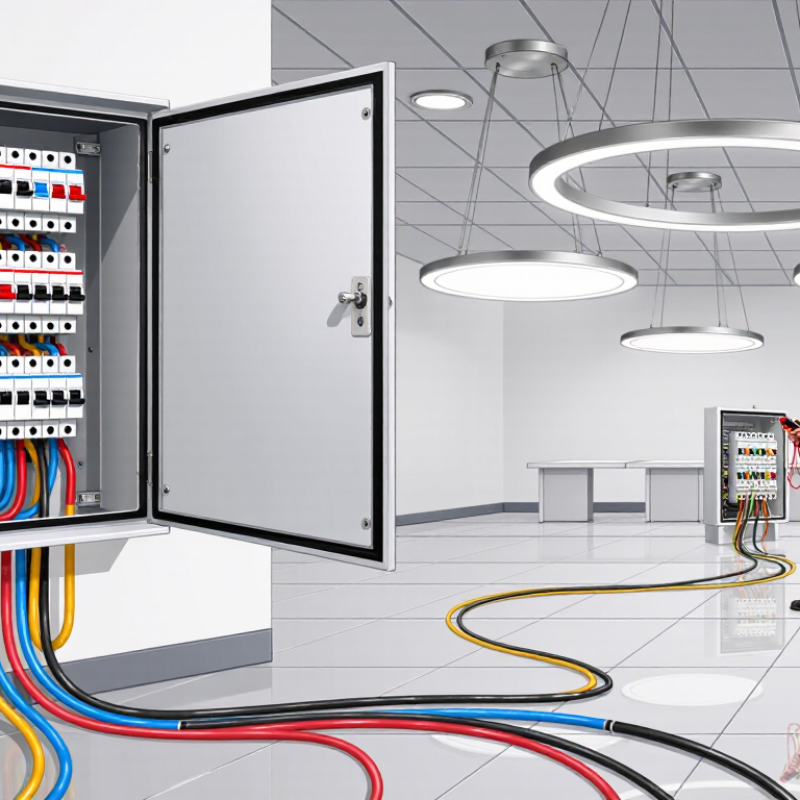
Why Does LED Lighting Cause RCBO Nuisance Tripping?
An RCBO monitors two different faults. Its circuit breaker section detects overloads and short circuits. Its residual-current section compares current leaving the line conductor with current returning through neutral. Any imbalance flows elsewhere, often through protective earth, and the RCBO may trip.
IEC 61009-1 covers RCBO performance, including common 30 mA residual-current protection. That threshold is small by design. LED drivers can create leakage through internal electromagnetic-interference filters, especially when many fittings share one circuit. Their rectifiers and capacitors can also produce short inrush pulses. These pulses usually challenge the overcurrent section, while filter leakage challenges the residual-current section. The distinction matters. A lamp swap alone may not reveal the cause.
The IET’s Guidance Note 6 advises controlling cumulative protective-conductor current, with 30% of an RCD’s rated residual operating current often used as a practical planning limit. For a 30 mA device, that is about 9 mA. Ten LED fittings leaking only 1 mA each can approach that level. Real installations are less tidy. Wiring capacitance, moisture, dimmers, and aging drivers can add uncertainty.
Tips: Measure leakage with a suitable clamp meter around line and neutral together. Test the circuit cold and during switching. Check whether the RCBO type suits electronic LED loads, and ask a qualified electrician to assess neutral-earth faults before replacing the device. A higher trip rating is not automatically a safer answer.
LED lighting can cause RCBO nuisance tripping when its driver creates leakage current. The driver converts AC power into low-voltage DC power. During this process, internal suppression components can send a small current toward earth. This is often normal, but several fittings can create a larger combined value.
In field inspections, I have found that one LED fitting rarely explains repeated trips. Ten fittings may be different. Their leakage currents add together, especially on long circuits with many drivers. An RCBO detects an imbalance between live and neutral conductors. It may trip even when the circuit has no overload. Inrush current can also confuse the diagnosis, although it is not the same as residual current. The distinction matters.
Tips: Switch off fittings one circuit at a time. Record the leakage reading. Check wiring insulation, earth connections, and driver specifications. A qualified electrician should confirm the correct RCBO type under local requirements. Do not simply install a higher-rated device. That can hide a fault. I have also seen troubleshooting stop too early after replacing one driver. That was a mistake. Leakage from several small sources may remain, and temperature, moisture, or aging components can change the result. Short tests can mislead. Test under normal operating conditions.
LED lighting can trip an RCBO because its driver does not behave like a simple resistive lamp. When power is switched on, an input capacitor may charge almost instantly. The resulting inrush current can briefly reach 10 to 100 times the normal operating current, according to measurements discussed in electrical power-quality guidance from the Electrical Power Research Institute. The surge lasts only milliseconds, but an RCBO responds to current magnitude and duration, not the installer’s intention.
The problem becomes worse when many fittings start together. A corridor with twenty LED luminaires can create one sharp switching surge. Long cable runs may also increase transient effects. The International Energy Agency reports that lighting still represents roughly 10% of global electricity demand, so this issue is no longer limited to small installations. Driver filters can add earth leakage, too. Several small leakage currents may combine and approach the RCBO’s residual-current threshold.
A larger RCBO is not automatically the correct fix. Its cable protection, disconnection time, and leakage limits still require verification under IEC 61009 principles. Check the manufacturer’s measured inrush data, divide fittings across circuits, and consider controlled switching. A power-quality recorder can reveal the real waveform. Guessing is tempting. It is also where troubleshooting often goes wrong. Even careful calculations may miss ageing capacitors, shared neutrals, or simultaneous occupancy switching.
| LED Lighting Condition | Typical Electrical Event | Approximate Magnitude or Duration | How It Can Affect an RCBO | Likely Trip Type | Relative Nuisance-Trip Risk | Practical Corrective Action |
|---|---|---|---|---|---|---|
| Large group of LED drivers switched on simultaneously | Capacitor-charging inrush current through the input rectifier and DC-link capacitor | Commonly 5–30 times the steady-state current; typically lasting from less than 1 ms to several milliseconds | A high-current pulse can cause the protective device's instantaneous or short-time magnetic element to operate, especially when many fittings share one circuit | Overcurrent or instantaneous trip | High | Divide fittings across more circuits, stagger switching, reduce the number of drivers per switching device, and verify the protective-device characteristics against the measured inrush profile |
| LED driver with active power-factor-correction circuitry | High-frequency switching and input-current distortion during startup or load changes | Short high-frequency components superimposed on the normal 50/60 Hz current waveform | Rapid current changes may increase electromagnetic interference and can interact with the RCBO sensing and filtering arrangement | Possible overcurrent or residual-current trip | Medium | Use compatible drivers, check installation wiring, keep high-frequency noise paths short, and follow the driver manufacturer's maximum circuit-loading guidance |
| Switch-mode LED driver with EMI suppression capacitors | Small capacitive leakage current from line and neutral to protective earth | Usually measured in milliamperes; increases as more drivers are connected in parallel | The combined leakage current may approach the RCBO residual-current operating level even when there is no insulation fault | Residual-current trip | High | Measure leakage current with all loads operating, distribute equipment across circuits, inspect filters and cables, and maintain adequate margin below the RCBO rated residual operating current |
| Long cable runs supplying LED luminaires | Cable capacitance produces charging and high-frequency leakage current | Dependent on cable length, cable construction, switching frequency, and connected driver count | Additional capacitive current adds to driver leakage and may cause unwanted residual-current operation during switching | Residual-current trip | Medium | Separate heavily loaded lighting branches, avoid excessive cable lengths where practical, and test each branch independently |
| Switching a lighting contactor or relay | Inductive coil switching surge and contact bounce | Voltage transient may reach several times the normal supply voltage for microseconds to milliseconds | The transient can couple into nearby conductors, create a brief differential current, or stress sensitive electronic drivers | Possible residual-current or overcurrent trip | Medium | Fit an appropriately rated suppression device at the coil, use suitable switching hardware, and separate control wiring from sensitive power and data cables |
| LED driver failure or degraded insulation | Leakage from line or neutral to earth caused by damaged components, moisture, contamination, or insulation breakdown | May be intermittent or increase with temperature and operating time | Creates a genuine residual current rather than a harmless switching transient | Residual-current trip | High | Do not repeatedly reset the RCBO; isolate branches, perform insulation and leakage-current tests, and replace defective luminaires or drivers |
| Neutral-to-earth connection downstream of the RCBO | Part of the load current returns through the protective-earth path instead of the monitored neutral conductor | Can occur continuously or only when a particular lighting circuit is energized | The RCBO detects an imbalance between line and neutral and trips even though the load current may be normal | Residual-current trip | High | Inspect junction boxes, distribution boards, shared neutrals, and accessories; remove any neutral-earth connection downstream of the RCBO |
| Shared neutral between separate RCBO-protected circuits | Neutral current returns through a different RCBO sensing path | Occurs whenever the affected circuits carry unequal or changing loads | The sensing toroid sees an imbalance and interprets it as leakage to earth | Residual-current trip | High | Confirm that each line conductor is paired with its correct neutral and that neutrals are not mixed between independently protected circuits |
| Multiple LED circuits energized at the same instant | Superposition of several inrush-current pulses and leakage-current steps | Highest stress occurs immediately after restoration of supply or operation of a common control signal | The combined transient may exceed the RCBO's instantaneous response threshold or its residual-current operating threshold | Overcurrent or residual-current trip | High | Use staged or sequential switching, split the installation into smaller groups, and avoid connecting the entire LED load to one switching point |
| High ambient temperature around LED drivers | Increased electronic component stress and possible rise in leakage current | Effect develops over minutes or hours rather than only at switch-on | Thermal drift may increase driver leakage, cause intermittent faults, or reduce the reliability of internal suppression components | Usually residual-current; occasionally overcurrent | Medium | Improve ventilation, avoid exceeding the driver's rated ambient temperature, check luminaire thermal management, and replace heat-damaged drivers |
| Normal steady-state LED operation with excessive circuit loading | Continuous current close to the circuit protective rating | Persists during normal operation; temperature rise may worsen the condition | Thermal protection may operate after a delay, particularly when inrush is added to an already heavily loaded circuit | Thermal overcurrent trip | Medium | Calculate connected load, measure operating current, allow for driver power factor and inrush, and redistribute luminaires if necessary |
| Electromagnetic disturbance from nearby equipment | Fast voltage transients caused by motors, transformers, contactors, or variable-speed equipment | Typically microseconds to milliseconds, depending on the source and switching arrangement | Transient coupling can disturb electronic drivers and produce short-lived current imbalance or control malfunction | Possible nuisance residual-current trip | Low to Medium | Improve circuit segregation, verify earthing and bonding, suppress inductive loads, and consider suitable transient protection following a qualified assessment |
LED lighting can trip an RCBO even when the lamps appear healthy. The installation often creates the real problem. LED drivers contain electronic components that produce small leakage currents. Several fittings can add these currents together. A long cable run may also increase capacitive leakage, especially in older installations.
Incorrect neutral arrangements are a common cause. A borrowed neutral, loose neutral connection, or shared neutral can upset the RCBO’s current balance. Mixing circuits inside a junction box may create similar symptoms. Dimmers, emergency lights, and illuminated switches can add unwanted current paths.
Poor terminal torque deserves attention too. A slightly loose connection can create heat, noise, and intermittent tripping. It is easy to blame the LED lamp too quickly. I have seen the same fitting operate normally after a wiring fault was corrected.
Tips: Record when the RCBO trips. Note the number of lights operating, recent changes, and whether rain or darkness affects the event. A qualified electrician should test insulation resistance, neutral separation, protective conductor current, and circuit polarity. They should also check the RCBO type, rating, and connection torque against the installation design. Replacing the RCBO alone may hide the cause rather than fix it. In some cases, reducing the number of fittings on one circuit helps. However, that choice needs measured results, not guesswork. LED compatibility should be checked under actual load conditions, because a bench test may not reveal a site problem.
Why Does LED Lighting Cause RCBO Nuisance Tripping?
LED lighting can trip an RCBO because electronic drivers create small leakage currents. Several fittings may combine their leakage and exceed the RCBO’s residual-current threshold. Inrush current can also trigger the overcurrent function when many lamps start together. The fault may appear only at switch-on, after warming, or during a storm. That timing matters.
Use a step-by-step diagnosis. Record exactly when the RCBO trips. Does one circuit cause it, or does the whole installation respond? Isolate the lighting circuit, then reconnect fittings one at a time. A qualified electrician should measure earth leakage with suitable test equipment and inspect neutral connections carefully. A shared or loose neutral can create confusing symptoms. Insulation testing must follow safe procedures, because test voltage can damage connected electronics. Do not simply install a higher-rated protective device.
Tips: Check the total leakage current, not just each lamp. Confirm the RCBO type suits electronic lighting under local requirements. Separate large lighting groups if practical, and replace damaged or poor-quality drivers. Keep terminals tight and dry. A recorded baseline helps future maintenance.
Prevention depends on the real cause. Select fittings with documented electrical performance and suitable inrush characteristics. Avoid mixing questionable drivers on one heavily loaded circuit. In older installations, hidden neutral faults may be the real problem. I have seen technicians blame the lamps too quickly; that assumption can waste time. Retest after every change, and document the result. Sometimes the first diagnosis is wrong.
Step-by-step diagnostic view: residual current from LED drivers can increase during energisation and approach the RCBO operating threshold.
It monitors overloads, short circuits, and residual-current leakage. It compares current leaving through line with current returning through neutral. An imbalance may flow through protective earth. Then, it may trip.
Each electronic driver may leak a small current through its interference filter. Ten fittings leaking about 1 mA each can approach 9 mA. A 30 mA residual-current device may then trip unexpectedly. Small currents add up.
An LED driver’s input capacitor charges rapidly when switched on. The brief inrush current may reach many times its normal operating current. Twenty corridor fittings starting together can create one sharp surge. The event lasts milliseconds.
Yes. A trip during switch-on may suggest inrush current. A trip after warming may indicate changing leakage or an aging driver. Storms and moisture can also affect leakage. Timing provides clues.
Record the exact time and operating condition of every trip. Isolate the lighting circuit, then reconnect fittings individually. Measure leakage around line and neutral together with suitable equipment. Check neutral connections carefully.
Not automatically. A higher rating may reduce sensitivity without fixing the fault. Cable protection, disconnection time, and leakage limits still require verification. A larger device could hide a dangerous condition. Do not guess.
Shared neutrals, loose terminals, moisture, long cables, and aging capacitors can contribute. Dimmers and wiring capacitance may increase uncertainty. Poor connections can create confusing symptoms. The lamps may not be responsible.
Choose fittings with documented leakage and inrush characteristics. Divide large lighting groups across separate circuits when practical. Keep terminals tight and dry. Retest after every change and record the result. The first diagnosis may be wrong.
Why does LED lighting cause rcbo nuisance tripping? An RCBO can trip when it detects residual current leaking from a circuit, or when current exceeds its overcurrent threshold. LED drivers may create small leakage currents through their internal components, and several lights on one circuit can add these currents together. Switching can also produce brief inrush currents or surges, especially when many drivers turn on at once, potentially causing unwanted trips.
Installation conditions may make the problem more likely, including wiring faults, shared neutrals, poor connections, moisture, or an overloaded circuit. To diagnose the cause, switch off and isolate lighting sections one at a time, check the wiring and connections, and have leakage and inrush currents measured with suitable equipment. Then address any faults, distribute the load where appropriate, and use compatible protective devices. A qualified electrician can help identify the source safely and prevent repeated tripping.
