Bowser Electric Bowser Electric

How to Choose the Right Circuit Breaker for EV Charging?

Time:2026-10-05 Author:Madeline
0%

Choosing an EV charger is not only a question of charging speed. It is also a question of heat, cable capacity, fault protection, and local installation conditions. Many homeowners ask, “what type of circuit breaker do I need for EV charging?” The safe answer depends on charger output, continuous current, conductor size, and the electrical panel’s available capacity.

The International Energy Agency reported that global electric car sales exceeded 17 million in 2024, increasing pressure on residential charging infrastructure. However, a larger EV market does not make every home circuit suitable. Under NFPA 70, EV charging is generally treated as a continuous load, so the branch circuit should normally support 125% of the charger’s maximum current. A 32-amp charger may therefore require a 40-amp circuit, subject to local code and equipment instructions. Small details matter. A warm socket matters. So does a long cable run.

Electrical safety educator Mike Holt summarizes the essential principle: “The circuit breaker protects the wire.” That sentence is simple, but easy to overlook. The breaker must match the conductor, not merely the charger label. Depending on the charger and local rules, a standard thermal-magnetic breaker, GFCI protection, or a dedicated protective device may be required. IEC 61851 and manufacturer guidance also influence the installation approach.

This guide examines breaker ratings, Type A or Type B residual-current protection, load calculations, and panel limitations. It also questions a common assumption: bigger is not always safer. A qualified electrician should verify the final design, because real installations rarely behave like perfect diagrams.
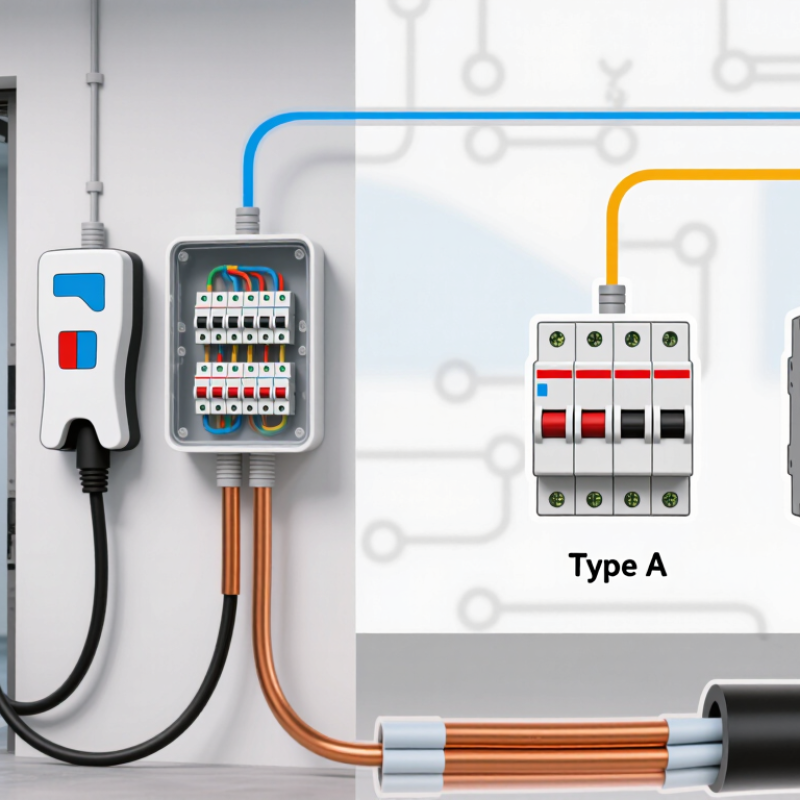
How to Choose the Right Circuit Breaker for EV Charging?

Define EV Charger Voltage, Phase, and Maximum Continuous Current

Choosing an EV charger circuit breaker starts with three facts: input voltage, phase, and maximum continuous current. The vehicle battery voltage is not enough. Check the charger nameplate and installation manual.

A 7.4 kW charger on a 230 V single-phase supply draws about 32 A. A 11 kW charger on a 400 V three-phase supply draws roughly 16 A per phase. The calculation changes with power factor and efficiency. Reality is less tidy. I would recheck the supply voltage under load.

Charging is usually a continuous load. The National Electrical Code recommends sizing conductors and overcurrent protection at 125% of the charger’s maximum continuous current. A 32 A charger may therefore need a 40 A circuit, subject to local rules and equipment instructions. Do not simply install the largest breaker. Cable capacity, temperature, installation method, and fault protection must agree.

The International Energy Agency reported more than 14 million electric cars sold globally in 2023, while public charging points increased by over 40%. That growth makes accurate circuit design increasingly important. The U.S. Department of Energy’s Alternative Fuels Data Center separates charging equipment into different power levels, reinforcing that “EV charger” is not one electrical category. Confirm whether the unit uses single-phase or three-phase power. Confirm its maximum current. Then have a qualified electrician verify the panel capacity and local requirements. Small assumptions can become expensive.

Calculate Breaker Size at 125% of the EV Charging Load

Choosing the right circuit breaker for EV charging starts with the charging load, not the vehicle’s battery size. EV charging is treated as a continuous load under NFPA 70, commonly known as the National Electrical Code. The branch-circuit rating should generally be at least 125% of the charger’s maximum continuous current.

For a 32-amp charger, the calculation is simple:
32 × 1.25 = 40 amps.

A 48-amp charger requires 60 amps under the same method.

Keep the math visible.

The charger rating is only one part of the decision. The conductor ampacity, panel capacity, installation temperature, voltage, and local requirements must also support the selected breaker. A larger breaker cannot correct undersized wiring.

The International Energy Agency reported more than 14 million electric cars were sold worldwide in 2023, representing nearly 18% of new-car sales in its Global EV Outlook 2024. That growth makes careful residential load planning more important, especially in older homes with electric heating or crowded service panels.

A load calculation may reveal a smaller safe charger setting. That is not a failure. It is often the more reliable design. Have a qualified electrician verify the installation and confirm the applicable local code before energizing the circuit.

Match Breaker Poles to 120 V, 240 V, or Three-Phase Service

Choosing the right circuit breaker for EV charging starts with the service voltage and phase arrangement. The breaker poles must match the charger’s input design, not just its advertised power. A 120 V charger usually uses one hot conductor and a neutral, requiring a single-pole breaker. It is common for portable charging. A 240 V charger normally uses two hot conductors from a split-phase panel, requiring a two-pole breaker. Both poles disconnect together.

Three-phase service requires closer attention. A three-pole breaker connects the charger to all three phase conductors and must match the charger’s rated voltage. Some systems provide 208 V between phases, while others provide 240 V. They are not interchangeable assumptions. Check the equipment label and measure the supply at the panel. Small details matter.

The breaker rating must also reflect continuous EV charging, conductor ampacity, panel capacity, and local electrical requirements. A charger drawing 32 amps for several hours should not be treated like a short household load. The circuit often needs additional capacity under applicable codes. Ground-fault protection may also be required.

I have seen installations fail because someone counted voltage but ignored poles. That mistake can damage equipment or create a dangerous condition. The neutral is not automatically needed for every 240 V charger, and three-phase equipment may or may not use one. A qualified electrician should verify the service, torque connections correctly, and confirm breaker compatibility. The part I still check twice is phase identification. Labels can be unclear.

How to Choose the Right Circuit Breaker for EV Charging?

Match the breaker poles to the EV charging supply: 120 V single-phase circuits typically use one pole, 240 V split-phase circuits use two poles, and three-phase supplies use three poles.

Typical circuit arrangement: A 120 V Level 1 charger is generally supplied by a single-pole circuit. A 240 V Level 2 charger requires a two-pole breaker so both ungrounded conductors are disconnected together. Commercial three-phase EV charging equipment requires a three-pole breaker matched to the site’s three-phase voltage. Final breaker sizing must also account for the charger’s rated current, continuous-load requirements, conductor ampacity, and local electrical regulations.

Verify Panel Capacity, Wire Ampacity, and 80% Continuous-Load Limits

Choosing the right circuit breaker for EV charging starts at the electrical panel, not the charging connector. Check the panel’s main rating, bus capacity, and existing demand. A 60-amp breaker does not automatically provide 60 available amps. Ovens, dryers, heat pumps, and other large loads may already consume much of that capacity. A demand calculation can reveal whether the panel can support the charger without nuisance trips or overheating.

Wire ampacity must match the breaker and installation conditions. Confirm the conductor size, insulation rating, conduit fill, distance, and ambient temperature. Longer runs can increase voltage drop. That detail is easy to miss. The breaker protects the wiring, so increasing breaker size to stop tripping can create a dangerous mismatch.

EV charging is usually treated as a continuous load because it may run for several hours. Under the common 80% rule, a 50-amp breaker typically supports a continuous load of up to 40 amps, unless the equipment and applicable electrical rules allow another arrangement. Do not rely on the charger’s advertised maximum alone. Verify its configured output, the installation manual, and local requirements. A neat calculation can still be incomplete if future household loads are ignored. Have a qualified electrician inspect the panel, test connections, and confirm the final breaker and conductor selection before energizing the circuit.

Confirm GFCI, AFCI, SCCR, and Local Code Requirements Before Installation

Choosing a circuit breaker for EV charging starts with more than matching voltage and amperage. Confirm the charger’s continuous-load rating, then size the circuit according to local electrical rules. A dedicated circuit is commonly needed, especially when charging runs overnight for several hours.

GFCI protection deserves careful attention. Many jurisdictions require it for EV supply equipment, but the exact method can vary. AFCI requirements may also apply when the charger is installed in a dwelling or finished area. Check the current local code, not an old installation guide. A small misunderstanding here can create nuisance trips or leave a protection gap.

SCCR is another critical check. The charger and protective device must withstand the available fault current at the installation point. Compare the equipment rating with the panel’s short-circuit capacity and the utility’s available data. I have seen projects delayed because this detail was reviewed too late. Inspect the panel label, conductor size, breaker compatibility, and terminal torque before energizing. A qualified electrician should verify the calculation and installation. Online charts help, but they do not replace an on-site assessment. The code interpretation may still need correction.

How to Choose the Right Circuit Breaker for EV Charging? - Confirm GFCI, AFCI, SCCR, and Local Code Requirements Before Installation

Selection Dimension What to Confirm Typical Technical Guidance Example Data Installation Decision
EVSE Input Voltage Verify the charger nameplate voltage and the building supply voltage. Common residential supplies are 120 V or 208/240 V single-phase. The breaker must be compatible with the circuit voltage and system configuration. EVSE rated 208/240 V, single-phase Use a breaker listed for the supply voltage and number of poles required by the EVSE installation instructions.
Continuous Load Rating Determine the maximum input current and whether charging will operate for three hours or more. EV charging is generally treated as a continuous load. Size the branch circuit and overcurrent protection at not less than 125% of the maximum continuous charging current, unless the applicable code provides another method. 32 A continuous charging current × 125% = 40 A minimum circuit rating A 40 A circuit may be appropriate only when conductor ampacity, terminals, equipment ratings, and local code requirements also support it.
Breaker Ampere Rating Compare the calculated load with the EVSE maximum overcurrent protection requirement. The breaker must not exceed the allowable ampacity of the conductors and must comply with the EVSE listing and installation instructions. 40 A breaker for an EVSE limited to 32 A continuous output Do not select a larger breaker merely to prevent nuisance tripping; investigate load, wiring, temperature, and equipment conditions first.
GFCI Protection Confirm whether ground-fault circuit-interrupter protection is required and whether it is built into the EVSE or provided by the breaker. For many North American installations, EV supply equipment receptacle or branch-circuit requirements can require GFCI protection. The applicable electrical code, EVSE listing, and installation location control. Outdoor or garage installation with a receptacle; EVSE has integral ground-fault monitoring Avoid unintentionally installing two incompatible GFCI devices. Confirm compatibility, test-button access, neutral arrangement, and manufacturer instructions.
AFCI Protection Check whether the circuit location and occupancy require arc-fault protection. AFCI rules vary by adopted code edition and jurisdiction. Dwelling-unit locations such as garages or other areas may be subject to local AFCI provisions, exceptions, or special EVSE rules. New dwelling-unit circuit installed in a location covered by the locally adopted AFCI requirements Use an AFCI or dual-function device only when required and when it is listed and compatible with the EVSE and wiring method.
SCCR and Available Fault Current Determine the available short-circuit current at the installation point and compare it with the breaker and EVSE short-circuit current ratings. The equipment SCCR or interrupting rating must be adequate for the available fault current. The rating is commonly expressed in kAIC or kA. Available fault current: 8 kA; breaker interrupting rating: 10 kA minimum Do not use a breaker with an interrupting rating below the calculated available fault current. A utility or qualified electrician may be needed for the calculation.
Conductor Ampacity Verify conductor size, insulation temperature rating, terminal ratings, installation method, and adjustment factors. Conductor ampacity must support the calculated continuous load after applicable derating. The final rating can be affected by ambient temperature, conduit fill, bundling, and termination limits. 40 A circuit with conductors selected and installed to meet the locally applicable ampacity rules Never choose the breaker independently of the conductors and terminations.
Panel and Service Capacity Check the load calculation, service rating, panel bus rating, breaker spaces, and compatibility with the panelboard. A new EV load can require a formal dwelling or commercial load calculation. Panel labeling and breaker type must match the listed equipment. Existing panel with limited spare capacity and several large continuous loads Consider managed charging, load management, a service upgrade, or a dedicated subpanel when permitted by the design and code.
Breaker Poles and Neutral Confirm whether the EVSE requires line-to-line power, line-to-neutral power, or a neutral conductor. Many 208/240 V Level 2 EVSE installations use two ungrounded conductors and an equipment grounding conductor, but the exact arrangement depends on the EVSE design. Two-pole, 208/240 V circuit with no neutral when permitted by the EVSE instructions Use a common-trip multi-pole breaker where required; do not assume a neutral is unnecessary without checking the wiring diagram.
Installation Location Identify whether the EVSE is indoors, outdoors, in a garage, in a wet location, or in a commercial parking area. Location can affect GFCI, AFCI, weatherproofing, disconnecting means, equipment protection, wiring methods, and accessibility requirements. Wall-mounted EVSE in an attached residential garage Confirm the locally adopted code, permit requirements, and inspection conditions before selecting the final breaker.
Breaker and EVSE Listing Verify that the breaker and EVSE are approved for the intended application and installation method. Use listed, properly identified equipment. Follow the EVSE instructions for maximum overcurrent protection, conductor requirements, torque values, and protection features. EVSE instructions specify a maximum 50 A overcurrent protective device Select a breaker within the stated limit and compatible with the panel and applicable certification requirements.
Local Code and Permit Review Confirm the adopted electrical code edition, amendments, utility rules, permit process, and inspection requirements. GFCI, AFCI, disconnects, trench depth, receptacles, load management, and service requirements can differ by jurisdiction. Local authority requires permit approval and inspection before energizing the EV charging circuit Treat local code confirmation as a mandatory step, not an optional final check.
Final Verification Inspect torque, conductor identification, grounding, polarity, GFCI/AFCI operation, voltage, and functional charging performance. Testing should follow the equipment instructions and applicable electrical safety procedures. Recheck for heat, nuisance trips, and abnormal voltage drop under load. Successful protection-device test and stable charging at the configured current Have installation and testing completed or verified by a qualified electrician where required.
Important: Final breaker selection depends on the EVSE nameplate, conductor ampacity, panel compatibility, available fault current, adopted electrical code, and the requirements of the local authority having jurisdiction. A qualified electrician should verify the installation before energizing the circuit.

FAQS

How many breaker poles does a 120 V EV charger usually need?

A 120 V charger usually needs a single-pole breaker. It uses one hot conductor and a neutral.

What breaker arrangement does a 240 V charger normally require?

A 240 V charger normally requires a two-pole breaker. Both poles disconnect together.

Which breaker is suitable for three-phase EV charging equipment?

Three-phase equipment usually needs a three-pole breaker. Confirm the rated voltage between phases.

Are 208 V and 240 V three-phase supplies interchangeable?

No. They are different supplies. Check the equipment label and measure voltage at the panel.

Does every 240 V charger need a neutral conductor?

No. Some 240 V chargers use two hot conductors only. Confirm the wiring diagram before installation.

How should panel capacity be checked before adding an EV charger?

Check the main rating, bus capacity, and existing household demand. Ovens and heat pumps may already use substantial capacity.

Why must wire ampacity match the breaker rating?

The breaker protects the wiring. Increasing breaker size can leave undersized conductors dangerously unprotected.

How does continuous charging affect breaker sizing?

EV charging may run for several hours. Under a common 80% rule, a 50-amp breaker supports about 40 continuous amps.

What protection requirements should be confirmed before energizing the circuit?

Check GFCI, AFCI, SCCR, and local electrical requirements. The exact protection method can vary by location.

What installation details are easy to overlook?

Long cable runs can cause voltage drop. Phase labels may also be unclear. I still check phase identification twice.

Conclusion

Choosing the right circuit breaker for an EV charger begins with identifying the charger’s voltage, phase configuration, and maximum continuous charging current. These details determine the required breaker rating and number of poles. As a general planning rule, calculate the breaker size at 125% of the EV charging load because charging is typically treated as a continuous load. For example, a charger drawing 32 amps continuously generally requires a circuit rated for at least 40 amps, subject to local requirements and equipment specifications.

The question “what type of circuit breaker do I need for EV charging” cannot be answered by amperage alone. Confirm whether the installation uses 120 V, 240 V, or three-phase service, then verify that the electrical panel has enough capacity, the conductors match the breaker’s ampacity, and the installation remains within applicable 80% continuous-load limits. Before installation, also confirm GFCI, AFCI, short-circuit current rating (SCCR), disconnect, grounding, and local electrical-code requirements with a qualified professional.

Madeline

Madeline

Madeline is a dedicated marketing professional with a wealth of expertise in our company's core offerings. With a keen understanding of the industry, she brings a unique perspective to her role, consistently delivering high-quality content that highlights the superior aspects of our products. As......